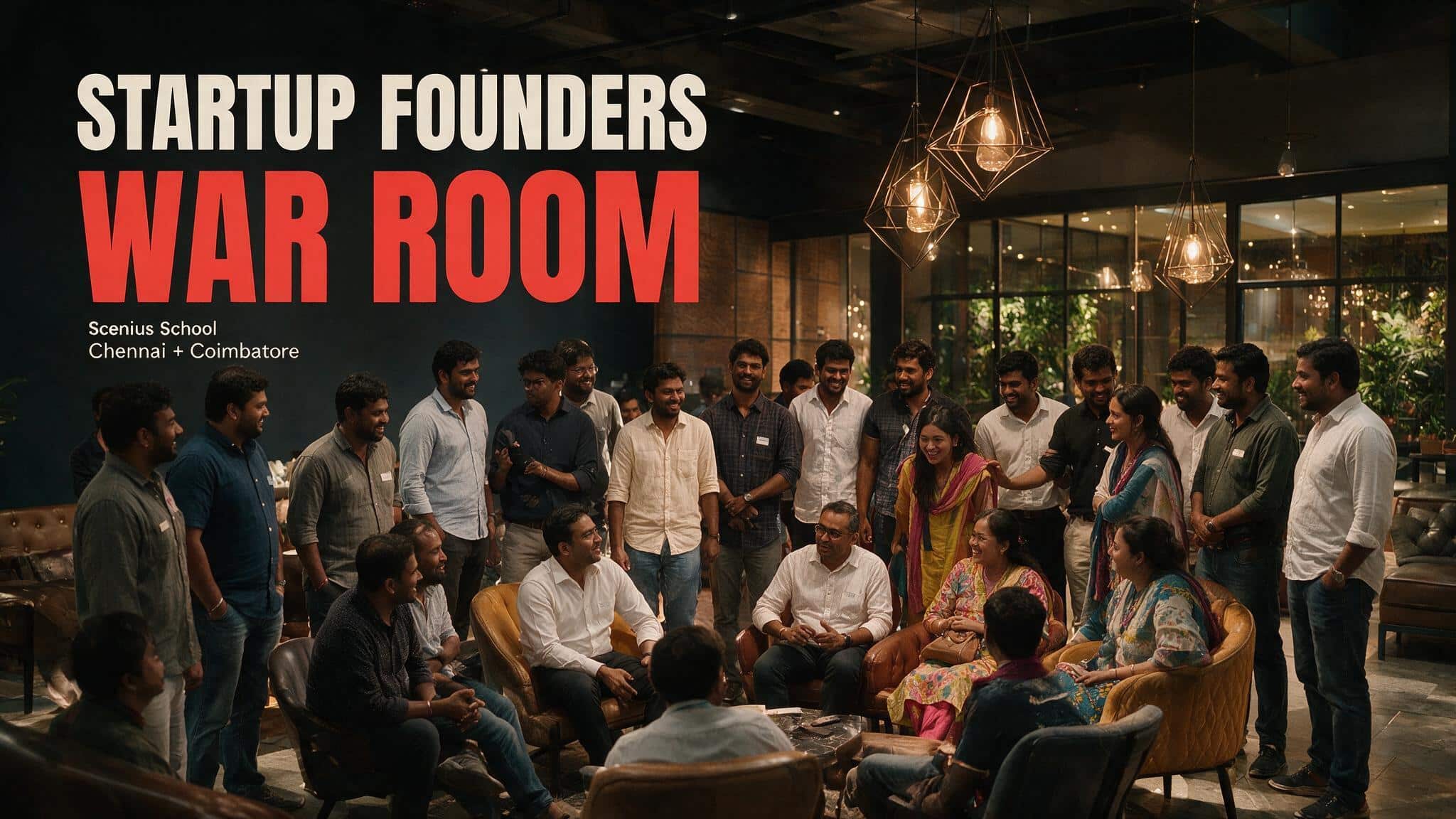
The Founder War Rooms held in Chennai and Coimbatore offered a useful reminder for anyone working with early-stage companies.
Across 40 founders, the businesses were varied—consumer services, retail, manufacturing, AI, wellness, healthcare, sustainability, hardware, deep tech and local commerce.
But the core questions were remarkably similar.
Should I build first or sell first?
Should I expand now or focus on one market?
Is customer interest the same as demand?
Should I raise capital—or first prove a repeatable operating model?
Am I solving a customer problem, or trying to create a market for an interesting solution?
The answers were not uniform. But several patterns were.
1. Operating reality beats presentation quality
The most compelling discussions did not necessarily come from the companies with the most polished technology, the most ambitious market-size narrative, or the clearest fundraising language.
They came from founders who had already operated in the real world.
They had sold. Delivered. Hired. Managed customer expectations. Faced delays, refunds, attrition, compliance, vendor challenges, working-capital constraints and uneven demand.
That kind of experience creates a more useful starting point for scale.
A founder who has learned why customers pay, where the operational bottlenecks are, and what breaks at higher volume is often further ahead than a founder with a refined product but limited contact with the market.
For investors and ecosystem builders, this is an important distinction.
A good deck can explain a market.
Only operating evidence can explain whether the business has earned a place in it.
2. Technology is not the business model
AI, automation and digital platforms featured repeatedly in the rooms. In some cases, technology was a genuine enabler. In others, it risked becoming the centre of the story before the commercial model was clear.
The relevant question is not: Can this be built?
It is:
- Who has a painful enough problem to pay for it?
- Why will they choose this instead of an existing alternative?
- What changes in their behaviour after adoption?
- Can this be sold and delivered repeatedly?
- Does the business get stronger as it grows?
A layer of technology over an existing workflow is not automatically a company.
The business begins where differentiation, distribution, customer value and economics become clear.
This is particularly important in crowded product categories. Building quickly is becoming easier. Creating sustained customer preference is not.
3. Interest is not validation
Many founders have access to encouraging signals: a positive pilot, a promising meeting, early registrations, social-media engagement, a verbal commitment or strong feedback from potential users.
These signals matter. But they are not all equal.
The most meaningful transition is usually from:
“This is interesting.”
to:
“I will pay for this now.”
Paid pilots, repeat orders, retained customers, referrals, improved contribution economics and willingness to commit resources are all stronger forms of evidence than attention alone.
This does not mean every business must monetise immediately. Some categories have longer sales cycles, regulatory complexity or deliberate product-development periods.
But founders should be clear about what exactly is being validated at each stage:
- Problem relevance?
- Customer willingness to try?
- Ability to acquire users?
- Willingness to pay?
- Repeatability?
- Unit economics?
- Scalability?
Confusing one form of validation for another is one of the most common ways early-stage businesses lose time.
4. Focus is often the highest-return strategy
A recurring temptation for founders is to add more:
More features.
More customer segments.
More cities.
More products.
More use cases.
More channels.
But expansion does not fix a weak core.
In several discussions, the better next move was not to broaden the business, but to deepen the evidence around one segment, one geography, one service line or one customer workflow.
A focused business can learn faster because the feedback loop is tighter.
It can identify why customers buy.
It can improve the delivery model.
It can see which costs are structural.
It can build a repeatable sales motion.
It can determine whether growth is genuinely working—or merely being subsidised by founder effort.
The question for an early-stage founder is often not, “How large can this become?”
It is, “What is the smallest version of this business that can work reliably and profitably?”
5. Capital should amplify clarity, not substitute for it
Many early-stage founders frame the next milestone as fundraising.
But capital is most useful when it accelerates a model that has already begun to reveal its logic.
Before raising, a founder should be able to explain:
- The specific customer and problem being solved.
- The wedge through which the company enters the market.
- The evidence that customers will pay.
- The economics of acquiring and serving them.
- The operating constraints that capital will help unlock.
- Why more money will create a better outcome than more learning at the current scale.
Capital can fund hiring, inventory, product development, market entry and growth.
It cannot, on its own, create customer pull, solve weak distribution, establish differentiation or correct a poorly understood business model.
The best founder conversations therefore begin before the fundraising conversation.
Better rooms, better decisions
The most valuable part of the Founder War Room format was not the advice offered from the front of the room.
It was the willingness of founders and operators to question each other’s assumptions openly.
A founder with experience in hiring could challenge a team-design decision.
An operator familiar with distribution could identify a channel constraint.
Someone who had built in a regulated category could surface risks that a product-first founder had not yet considered.
A founder with customer traction could remind the room that the market—not a pitch—ultimately decides.
This is what a useful founder ecosystem should enable.
Not only access to capital.
Not only exposure or networking.
But sharper decisions, earlier.
Because in the early stages of building, the right question can be more valuable than a quick answer.
The Founder War Rooms were conceptualised and run by Scenius School, with support from Rootd Ventures and Ishta Capital. Across Chennai and Coimbatore, the sessions brought together 40 selected founders from 200+ applications. The rooms were built around one simple idea: each founder brings one real decision, and the room helps test the assumptions beneath it.